
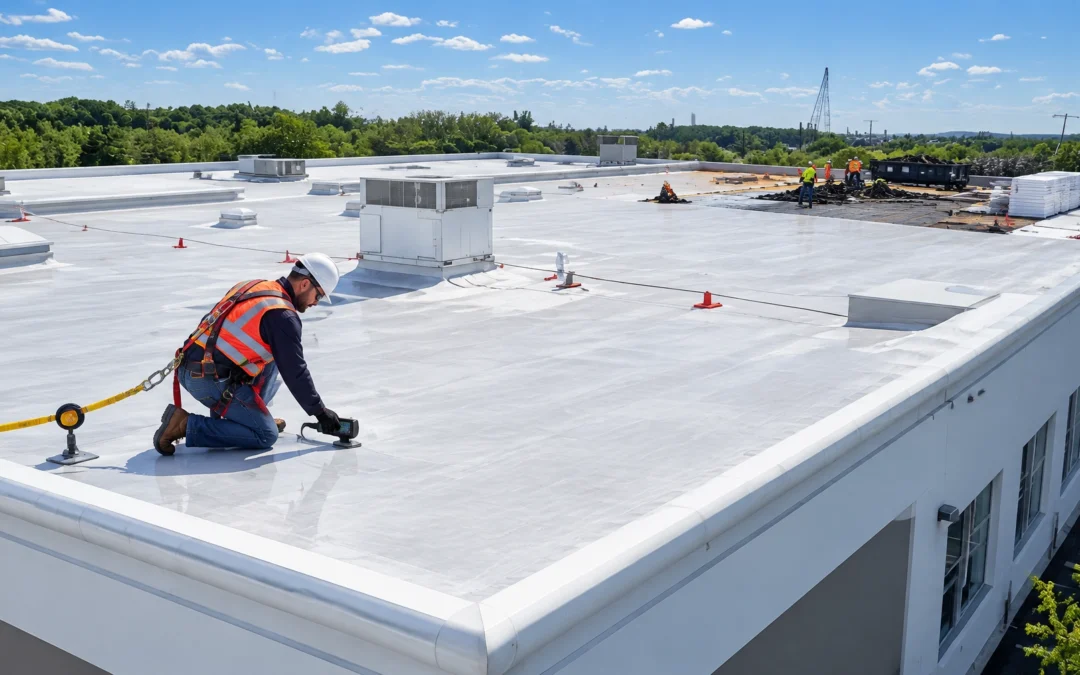
Is your commercial roof due for a full replacement, or could a carefully planned restoration protect your budget and buy your building more useful time?
For Texas property owners and facility managers, that decision can mean a major difference in upfront spending, business disruption, and long-term roof costs. But the cheapest proposal isn’t always the best value. A coating can be a smart investment on the right roof; on the wrong one, it can delay necessary repairs and cost you more down the road.
Here’s how to weigh flat roof coating against replacement with a clear view of both the roof and the numbers.
First, know what you’re comparing
A roof coating is a liquid-applied layer installed over an existing roof after inspection, repairs, and preparation. It can restore a roof that is still sound, rather than removing the existing assembly.
A replacement generally means removing some or all of the existing roofing system and installing a new one. It costs more upfront, but gives the contractor a chance to address problems below the membrane, including wet insulation or damaged decking.
Think of it like maintaining a work truck. Regular service can keep a healthy engine on the road; fresh paint won’t fix a cracked block. Coating is not a structural repair and is not a substitute for replacing a roof that has failed.
Compare the budget, not just the price per square foot
Costs vary with roof size, existing materials, access, drainage, insulation, penetrations, repairs, and tear-off requirements. As one planning reference, a Texas commercial roofing guide lists $4–$9 per square foot for silicone or acrylic coating and $12–$22 per square foot for TPO tear-off and replacement on sound substrates. These are market estimates, not a bid for your building; see the source’s cost assumptions.
For a 20,000-square-foot roof, those ranges would suggest roughly $80,000–$180,000 for coating or $240,000–$440,000 for a TPO tear-off and replacement. Your actual costs may land outside those ranges, especially if the inspection finds wet insulation, deck damage, difficult access, or drainage work.
Ask contractors to spell out what’s included. A low coating price may not include significant repairs or surface preparation. A replacement estimate should make clear whether it includes tear-off, disposal, insulation, edge metal, and deck repairs.
What matters more than the first invoice?
Look at cost across the time you’ll own the building
A coating usually has the lower upfront cost and can avoid tear-off and disposal. For an operating business, that may also mean less disruption for tenants, staff, customers, or inventory. But coatings are a maintenance strategy, not a permanent roof. Include inspections, upkeep, and any future recoating in your budget.
Replacement requires more capital now, but may make better financial sense if it gives you the service life your building needs and prevents recurring repair costs. It may also be the right opportunity to improve insulation, drainage, or other parts of the roof assembly.
A simple comparison can help:
Total ownership cost = installation + maintenance and repairs + future roofing work + likely disruption costs − applicable energy savings
Use written estimates and realistic planning assumptions rather than assuming a coating will always save money over the long term. A qualified inspection is the starting point for a fair comparison.

When might roof restoration make financial sense?
A coating may be worth considering if an inspection confirms the roof is structurally sound, dry, and suitable for the proposed system. That means the underlying roof can support the coating and does not have widespread damage that needs to be removed or rebuilt.
The roof’s existing material, drainage, seams, penetrations, and condition all matter. A contractor should explain how the roof will be evaluated and what repairs or preparation are needed before applying the product.
Texas Roof Magic’s commercial-only NanoTech® Cool Roof Coating is designed primarily to improve cooling and energy performance. The coating emits 94% of heat away from the roof, has the lowest thermal conductivity on the market, and can reduce roof surface temperatures by 50–70 degrees and HVAC use by up to 45%. On a roof that qualifies, it extends roof life by a minimum of 10 years and comes with a 10-year rolling warranty. Texas Roof Magic is a certified NanoTech® dealer and installer.
Those benefits may make a coating an appealing budget decision when the roof is a good candidate. But the product’s cooling performance does not mean it can repair structural damage or solve underlying roof-system failures.
When is replacement the more responsible choice?
If the roof has saturated decking, structural damage, or too much remaining wear, replacement may be the sounder investment. Persistent leaks, widespread deterioration, and damage below the roof surface also deserve a thorough evaluation. Putting a new layer over serious problems can hide them rather than fix them.
An honest contractor should explain the findings and recommend replacement when restoration isn’t appropriate, even if that’s not the cheaper option in the short term. For complex roofs, ask whether the inspection should include a moisture survey or other testing, and request the results in writing.
Wrong: Choose coating based only on a low square-foot price, or assume a coating will solve leaks without investigating their cause.
Right: Compare itemized proposals based on the actual roof condition, the work required, the expected service period, and the maintenance each option needs.
And what about the energy benefits in the budget?
Treat energy savings as a potential benefit, not a guarantee
A cooler roof can reduce heat transfer into a building, which may help limit cooling demand. But energy results depend on the building, its insulation, HVAC equipment, operation, and weather. Don’t build a budget around a promised savings percentage without checking whether it applies to your facility.
For NanoTech®, the cited potential is a roof surface temperature reduction of 50–70 degrees and an HVAC-use reduction of up to 45%. Those are potential performance benefits, not a guarantee that every building will see the same result. Review the roof’s condition and your facility’s energy use to judge whether cooling performance belongs in your financial comparison.

Get proposals that let you compare like with like
Before authorizing work, ask each bidder to provide:
- A written roof condition assessment, with photos and identified problem areas.
- The planned repairs and preparation, not just the coating or replacement product.
- A clear scope for insulation, drainage, penetrations, and any tear-off.
- Warranty terms, including maintenance obligations and exclusions.
- An explanation of what happens if concealed damage is discovered during the work.
- A realistic schedule and plan for minimizing disruption to your operation.
Texas Roof Magic uses CompanyCam to provide progress photos and communication during projects, so owners can follow along without climbing onto the roof themselves.
Key takeaways
- Coating often costs less upfront, but its value depends on roof condition and future maintenance.
- Replacement costs more initially and may be necessary to address saturated decking, structural damage, or widespread wear.
- Compare total ownership cost, not price per square foot alone.
- NanoTech® Cool Roof Coating is a commercial-only cooling and energy-performance service, not a structural repair or replacement for a failed roof.
- Ask for written findings and itemized proposals before committing to either path.
One important insurance note: a coating does not guarantee approval from an insurance underwriter. Before authorizing work, ask your broker to obtain your carrier’s exact requirements in writing.
If you’re weighing commercial roofing in Texas options, get an honest assessment before making a major budget commitment. Give Texas Roof Magic a shout for help reviewing whether your commercial roof may be a candidate for coating or whether replacement is the more responsible protection for your building.