
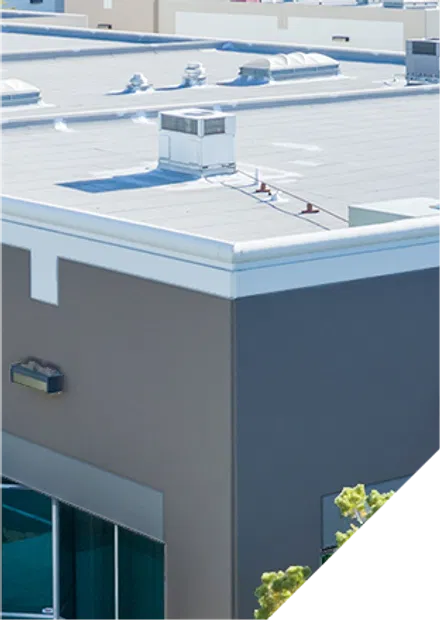
Could your commercial roof be putting your insurance coverage, and your capital budget, at risk simply because of its age?
For building owners and facility managers across Texas, the answer may be yes.
Commercial insurers are scrutinizing roof age and condition more closely than ever. Once a roof approaches the 15- to 20-year range, a carrier may require additional inspections, change the terms of coverage, increase premiums or deductibles, move claims from replacement cost to actual cash value, or issue a non-renewal notice.
Here’s the kicker: your roof may still appear serviceable, but your insurer may decide it no longer fits the company’s underwriting guidelines.
That creates a serious financial squeeze. You may not have budgeted for a six-figure roof replacement, yet losing coverage, or being forced into a much more expensive insurance market, can affect financing, leases, tenant requirements, and the overall value of your property.
For some commercial roofs, a professionally applied coating may provide a practical middle path at roughly 10% to 15% of the cost of a full replacement.
It is not the right solution for every roof. It is not a substitute for replacing a structurally failing system. And it is not a guarantee that any specific insurer will accept the work.
But when a sound existing roof needs documented protection and additional serviceable life, a coating may help you address an insurance requirement without immediately absorbing the cost and disruption of a complete tear-off.
Why the 15- to 20-Year Window Matters
Insurance carriers are not simply looking at whether a roof is leaking today. Underwriters are evaluating the likelihood and potential cost of future claims.
As a commercial roof ages, the carrier may become concerned about:
- Reduced remaining useful life
- Deteriorated seams, flashings, and penetrations
- Storm and hail vulnerability
- Ponding water
- Deferred maintenance
- Previous roof-related claims
- Lack of inspection or repair records
- The roof’s material and original installation date
- Whether the roof meets the carrier’s current guidelines
A roof that was acceptable five years ago may receive a very different response at the next renewal.
Depending on the carrier, the property may face:
- Non-renewal
- A requirement to replace the roof
- A roof exclusion
- Higher wind or hail deductibles
- Higher premiums
- A switch from replacement cost value to actual cash value
- Coverage limited to certain causes of loss
- Placement in a surplus or excess lines market
Commercial insurance rules and underwriting practices vary by carrier, roof material, property location, and policy language. There is no universal rule that every 15-year-old roof must be replaced.
However, the 15- to 20-year range has become a major underwriting pressure point for many Texas properties.
ACV vs. RCV: The Difference Can Be Substantial
Two insurance terms deserve special attention: replacement cost value and actual cash value.
Replacement cost value, or RCV, generally refers to the cost to replace damaged property with comparable new materials, subject to the policy terms and deductible.
Actual cash value, or ACV, typically accounts for depreciation. In plain English, the insurer may determine that an older roof is worth far less than the cost of installing a new one.
For example, imagine a commercial roof that would cost $250,000 to replace. If the policy pays on an ACV basis and the carrier applies significant depreciation because of age, the claim payment could be substantially lower than the replacement price.
The building owner may be responsible for the difference.
That is not a minor paperwork issue. It can turn a storm claim into a massive capital expense at exactly the wrong time.
Before renewal, ask your broker to explain:
- Whether the roof is covered on an RCV or ACV basis
- Whether a roof-specific endorsement changes the settlement
- What deductibles apply to wind, hail, and roof damage
- Whether wear and tear or deterioration exclusions apply
- What the carrier requires to continue coverage
You can also review general insurance guidance through the Texas Department of Insurance, then discuss your specific policy with your broker or insurance professional.
The Cost of Waiting Can Reach Beyond the Roof
A roof replacement is expensive on its own. But the financial consequences of an insurance problem may spread throughout the property.
A lender may require active property insurance as a condition of financing. A tenant may require the building owner to maintain certain coverage limits. A property management agreement may impose maintenance and insurance obligations. A buyer may view a non-renewal notice as a serious liability during due diligence.
If standard-market coverage disappears, the replacement policy may come with:
- Higher premiums
- Higher deductibles
- More restrictive exclusions
- Lower limits
- ACV-only roof coverage
- Limited wind or hail protection
Meanwhile, the owner is still expected to operate the building, protect inventory, serve tenants, and maintain the property.
That is why this is not merely a roofing problem. It is a risk-management and cash-flow problem.
A Realistic Cost Comparison
Every roof is different, and these figures are illustrations only. Actual costs vary based on roof size, system, access, materials, condition, penetrations, structural issues, labor, location, and market conditions.
As a broad planning example, a full commercial roof replacement may commonly run approximately $8 to $12 per square foot.
For a 25,000-square-foot commercial roof:
- At $8 per square foot: approximately $200,000
- At $12 per square foot: approximately $300,000
A professional roof coating applied at roughly 10% to 15% of replacement cost could represent an illustrative range of approximately:
- $20,000 to $45,000
That is a significant difference in upfront capital.
A coating does not eliminate the need to replace a roof that is failing. But if the existing roof is a suitable candidate, the application may help extend serviceable life, reduce heat transfer, and provide documentation for your insurance conversation.
The important step is to have the roof evaluated before assuming a coating is appropriate.
What a Commercial Roof Coating Can, and Cannot, Do
Texas Roof Magic’s flagship commercial solution is the NanoTech® Cool Roof Coat.
The coating is designed to help cool the building and extend the life of a suitable existing commercial roof. Its acrylic polymer technology emits approximately 94% of heat away from the roof and is designed with very low thermal conductivity, meaning it helps limit heat transfer into the building.
Depending on the building and conditions, the system can:
- Reduce roof temperatures by approximately 50 to 70 degrees
- Reduce HVAC use by up to 45%
- Extend roof life by a minimum of 10 years
- Provide a 10-year rolling warranty, subject to the applicable terms

The cooling benefit can be especially valuable for warehouses, distribution facilities, retail centers, manufacturing buildings, and other structures with large low-slope roof areas.
But let’s be clear:
NanoTech® Cool Roof Coat is NOT an alternative to replacing a structurally failing roof.
It does not repair rotten decking, correct major structural movement, or turn a severely damaged roof into a new roof. A professional evaluation must determine whether the existing membrane or roof system is sound enough to receive a coating.
Also, applying a coating does not automatically satisfy an insurer. The carrier must determine what it will accept.
Underwriters Want Proof, Not Promises
A verbal statement that “the roof is in good shape” may not be enough for an underwriter.
Insurance companies typically want documentation showing the property owner is actively managing the roof’s condition. That may include:
- Roof age and installation records
- A professional inspection report
- Photographs of the roof and problem areas
- Maintenance and repair history
- Evidence that leaks were addressed
- Documentation of ponding-water conditions
- Product information for repairs or coating
- Contractor credentials
- Warranty information
- Completion photographs
- A written statement of remaining useful life, when available
At Texas Roof Magic, we use CompanyCam to provide progress photos and project documentation. That creates a digital record of what was inspected, cleaned, repaired, or coated.
Commercial soft washing can also be part of a broader roof maintenance plan. Removing algae, mildew, stains, and debris helps keep the roof and surrounding property maintained and gives the owner better visual documentation. Soft washing is appropriate for both residential and commercial properties, while NanoTech® Cool Roof Coat is a commercial-only solution.

WRONG vs. RIGHT: Responding to an Insurance Requirement
WRONG: Ignore the notice
Waiting until coverage lapses can leave you scrambling for replacement insurance under pressure. You may have fewer options, less negotiating power, and a much larger bill.
WRONG: Hire the cheapest installer without documentation
A low bid may not help if the work is poorly prepared, inadequately documented, or rejected by the carrier. A white roof is not automatically a professionally installed roof coating.
RIGHT: Start before the non-renewal deadline
Ask for the carrier’s requirements as early as possible. Find out whether the insurer wants a repair, a coating, a roof certification, a full replacement, or another specific action.
RIGHT: Get the requirement in writing
Do not rely on a casual phone conversation. Ask your broker or carrier to provide the requirement, deadline, and acceptable documentation in writing.
RIGHT: Coordinate with your insurance broker
Your broker can help determine whether the proposed work addresses the carrier’s underwriting concern. Get the broker involved before authorizing the project.
RIGHT: Keep every record
Save the inspection report, photographs, proposal, product information, invoices, warranty, completion report, and written correspondence with the insurer.
The Automotive Analogy: Maintenance Before an Engine Failure
Think about your commercial roof like a delivery truck.
A truck with good maintenance records is easier to evaluate than one with no service history. Oil changes, repairs, inspections, and mileage records show that the owner has been paying attention.
A commercial roof works the same way.
A documented maintenance program does not make an old roof brand-new. But it can show that the owner is not ignoring the asset until water pours into the building.
That is the difference between proactive protection and an emergency reaction.
Key Takeaways for Texas Commercial Property Owners
- Commercial carriers are scrutinizing roof age and condition more aggressively, especially around the 15- to 20-year window.
- A roof may face non-renewal, ACV coverage, higher premiums, roof exclusions, or a replacement requirement.
- A full commercial roof replacement can cost hundreds of thousands of dollars.
- A coating may cost roughly 10% to 15% of replacement cost when the existing roof is a suitable candidate.
- NanoTech® Cool Roof Coat is designed for commercial cooling and roof-life extension, not as a replacement for a structurally failing roof.
- No coating guarantees insurance acceptance. Confirm the carrier’s requirements in writing before beginning work.
- A professional assessment, broker coordination, and complete documentation are essential.
- Do not wait until a non-renewal deadline is staring you in the face.
Protect Your Building Before the Renewal Deadline
If your commercial roof is approaching 15 years old, or your carrier has already raised questions, now is the time to gather facts.
Texas Roof Magic can help assess whether your roof may be a candidate for a commercial coating, soft washing, or additional maintenance documentation. We will not tell you a coating can solve a problem it cannot solve.
Our goal is to help you understand your options, protect your building, and make a better-informed decision before an insurance deadline turns into an emergency.
Contact Texas Roof Magic for a professional commercial roof assessment.